AI writing tools have transformed content production speed. What used to take a skilled writer 4 hours can now be drafted in 20 minutes. But the teams using AI to scale content successfully in 2025 are not just hitting generate and publishing — they are following a specific framework that preserves quality, protects rankings, and satisfies Google’s helpful content standards.
This guide decodes exactly how to use AI in your SEO content workflow without sacrificing the quality that earns rankings and the trust that earns customers.
Google’s Official Position on AI Content
Google’s position, confirmed in their 2024 core update guidance, is that they do not penalise AI-generated content — they penalise low-quality content, regardless of how it was produced.
Content created primarily to manipulate search rankings rather than genuinely help users is the target. The quality bar is the same whether a human wrote it in 4 hours or an AI drafted it in 20 minutes and a human refined it in 40 minutes. This is the framework: AI handles the speed, humans handle the quality, expertise, and experience signals that make content genuinely helpful and rankable.
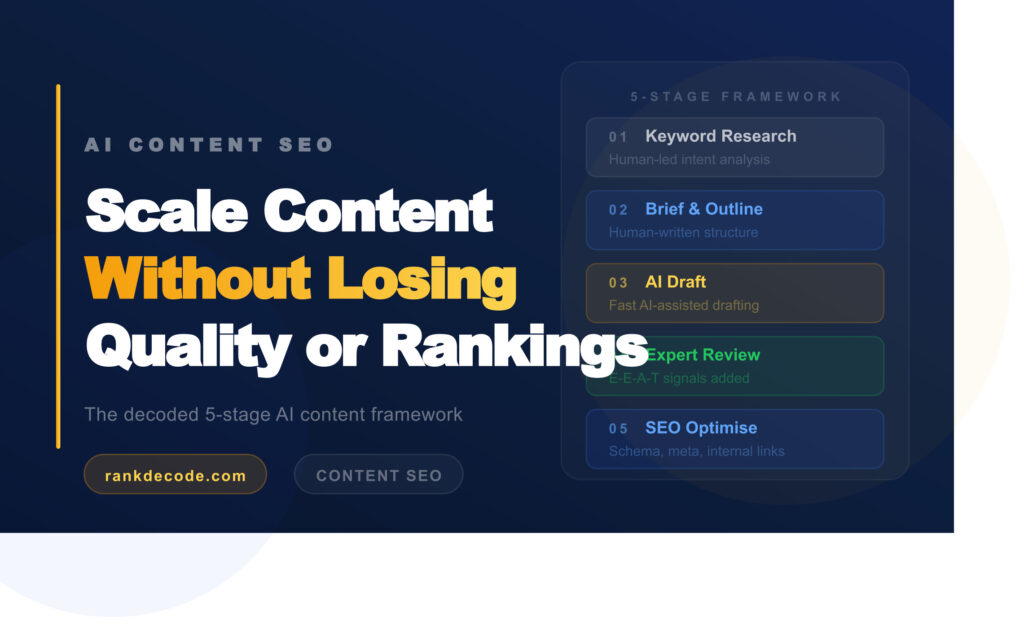
The 5-Stage AI Content Framework for SEO
Stage 1: Human-Led Keyword and Intent Research
AI cannot do this stage for you unsupervised. Keyword research requires judgment about search intent, commercial value, competitive difficulty, and topical fit that AI tools often misread. Use Ahrefs or Semrush to identify target keywords, then manually review the SERP for each target and ask:
- What format is Google rewarding — listicle, long guide, comparison, FAQ?
- What depth is Google rewarding in terms of word count and subtopic coverage?
- What unique angle is not already covered by the top 5 results?
- Does this keyword attract buyers or just browsers?
Document your intent analysis before starting any AI drafting. This becomes your brief.
Stage 2: Human-Written Brief and Outline
Do not ask AI to create the outline. Write it yourself. A strong brief specifies the primary keyword and 3 to 5 semantic variations, the intended reader and their problem, every H2 and H3 heading with a one-sentence description of what each section should cover, specific statistics or examples you want included, the unique angle this piece covers that competitors do not, and the tone you want throughout.
A brief that takes 20 minutes to write will save 2 hours of editing later.
Stage 3: AI-Assisted Drafting
With a solid brief in hand, AI can draft the body content quickly and to a reasonable standard. The best tools for SEO content drafting in 2025 are ChatGPT-4o, Claude, and Gemini Advanced for general drafting, and Surfer AI or MarketMuse for SEO-optimised drafting that builds in keyword density and semantic coverage automatically.
Prompting principles for quality SEO drafts:
- Provide your full brief in the prompt, not just the title
- Specify the word count range and format
- Ask for direct, concise sentences — AI defaults to verbose padding
- Request that statistics be flagged as [VERIFY] so you know which claims need sourcing
- Ask for one specific, concrete example in each major section
Stage 4: Human Expert Review and Enhancement
This is the most important stage and cannot be skipped. After the AI draft is complete, a subject matter expert reviews it and adds:
- First-hand experience signals — “In our work with automotive dealerships, we consistently see…” These E-E-A-T signals cannot be fabricated by AI and are the primary differentiator between content that ranks and content that plateaus.
- Verified statistics with sources — Replace every [VERIFY] flag with a real, cited statistic from a credible source.
- Unique insights — One or two observations from your actual experience that are not available in any other published source.
- Brand voice calibration — Rewrite any sections that sound generic or corporate.
- Internal links — Add 3 to 5 contextual internal links to related pages on your site.
Expect to spend 45 to 90 minutes on expert review for a 2,000-word article. Articles published without this stage perform significantly worse and carry Google helpful content risk.
Stage 5: SEO Optimisation Before Publishing
Before hitting publish, run through this checklist:
- Primary keyword in H1, first 100 words, at least one H2, and the meta description
- Semantic keywords distributed naturally throughout — use Surfer or Clearscope to verify
- Featured snippet optimisation — a direct 40 to 60-word answer to the primary question near the top of the article
- FAQ section with 4 to 6 questions using PAA-style queries pulled from the SERP
- Article schema markup applied
- Author bio with E-E-A-T credentials visible on the page
- Meta title under 60 characters and meta description under 160 characters
- Featured image with descriptive alt text
What to Never Use AI For in SEO Content
YMYL topics unsupervised. Medical, legal, financial, and safety content must be written or fully reviewed by a qualified expert. AI errors in these categories can cause genuine harm and Google actively downgrades unverified YMYL content.
Local references without verification. AI hallucination is particularly problematic with local facts — business names, addresses, and local statistics. Any locally-specific claim must be manually verified.
Testimonials or case studies. Never fabricate or AI-generate quotes, results, or client experiences. These must be real and verifiable.
Content Volume: Realistic Targets With This Framework
With the 5-stage framework, a single experienced SEO content professional can realistically produce:
- Solo consultant: 8 to 12 high-quality articles per month — up from 3 to 4 without AI assistance
- Small team of 2 writers plus 1 editor: 25 to 40 articles per month
- Agency content team of 5 writers: 80 to 120 articles per month
The key constraint shifts from writing speed to expert review capacity. Plan your hiring accordingly.
Measuring Whether Your AI Content Strategy Is Working
Track these metrics at 90 days and 180 days after implementing AI-assisted content production:
- Organic traffic per article — is AI-assisted content performing comparably to human-only content from 12 months ago?
- Average ranking position — are new articles achieving first page rankings within 90 days?
- Time on page and scroll depth — are readers engaging with the content or bouncing?
- Conversion rate from organic content — is the content driving leads and enquiries?
If any of these metrics decline after introducing AI content, the issue is almost always insufficient expert review in Stage 4. More AI volume with less human quality control is a downgrade, not an upgrade.
The Competitive Reality
Your competitors are already using AI for content. The question is not whether to use it — it is whether to use it well or badly. The framework above is how you use it well: AI handles drafting speed, humans provide the expertise, experience, and quality control that Google rewards and customers trust.
At RankDecode, every piece of content we produce for clients follows this exact framework. If you want help building a scalable, AI-assisted content strategy for your automotive, healthcare, or ecommerce business, get in touch — or run our free AI audit to see where your current content stands.